Keith Whyte @keith@tic-ac.org
Technology Coordinator / Rhizomatica.
Se unió el ago 2021
Hay gente (y ONGs) que siguen usado redes sociales corporativos (si no es oxímoron) y
deben entender bien que son plataformas que apoyan con su continuo uso;
- La mención de derechos civiles, feminismo o reformas sociales (temas centrales en la obra de Woolf) suele ser clasificada como 'tema social' por nuestros sistemas automáticos”. Y estos “temas sociales” son los que activan su rechazo.
Keith Whyte
retooteado

Analizamos el acuerdo entre el Gobierno Argentino y la empresa Starlink para dar internet a las Escuelas rurales y lo ponemos en contexto con el resto de países de la región para intentar responder esta pregunta: Starlink en las escuelas de América Latina: ¿caballo de Troya? Vos, ¿qué opinas?
https://radioslibres.net/starlink-y-las-escuelas-caballo-de-troya/
Keith Whyte
retooteado

I'm thinking about what a Local Internet looks like. Can we build a setup, local servers, local webdevs, local helpdesk. Get local businesses to pay us to make local pages. Organize local delivery drivers. What if we didn't scale?
Could we make it work? How big a city do we need?
Keith Whyte
retooteado
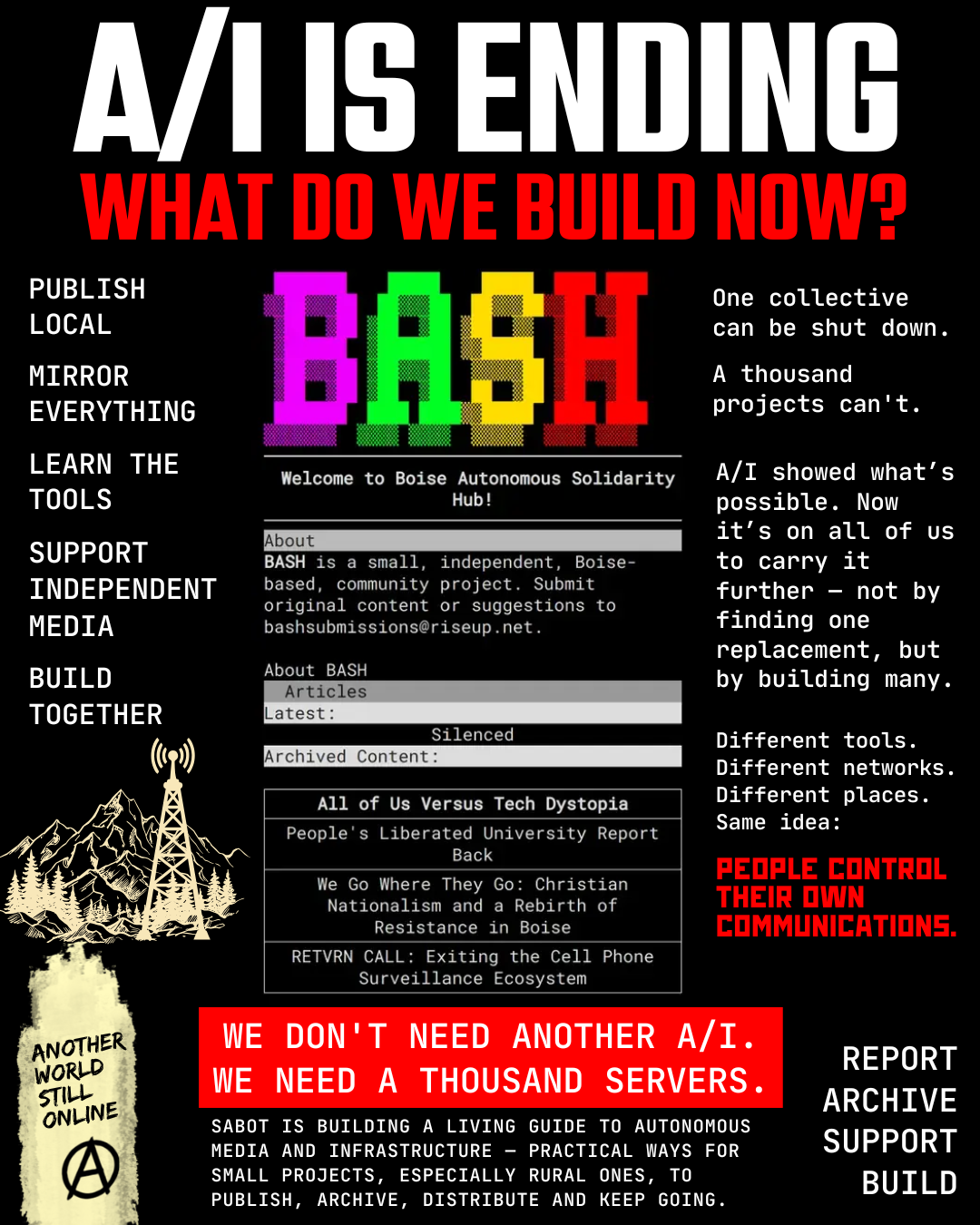
A/I may be ending. The story is nowhere near over.
For twenty-five years, #AutisticiInventati showed what it could mean for movements to build and control their own communications infrastructure. Its loss should not send everyone searching for the next single service to replace it.
It should send us looking in a hundred directions.
In Boise, the Boise Autonomous Solidarity Hub is experimenting with one of them. @BASH has put a small independent publication on NomadNet, a system running over Reticulum rather than relying solely on the conventional web. It has articles, archives, submissions and contact functions, reachable through a cryptographic network destination instead of an ordinary domain.
99a904b9ab830b7baa9d5115eb8854d7:/page/index.mu
That is not the answer. That's what makes it interesting.
Other projects are trying other things: cooperative infrastructure, self-managed servers, RSS, mirrors, print, radio, downloadable archives, federated publishing and networks that barely resemble the commercial web at all.
We don't need to find another A/I. We need to understand how to build a thousand different pieces of what made A/I possible.
Sabot is beginning a living guide to autonomous media and infrastructure, aimed especially at small and rural projects: how to publish, archive, distribute, host, mirror and keep going when a platform, host, domain, provider or collective disappears.
Coming Soon:
BECOME THE THOUSAND SERVERS
A living guide to autonomous publishing, infrastructure and survival
Follow the people experimenting. Follow small radical media. Preserve what matters.
Then build something.
Keith Whyte
retooteado

You do not own your DNS name, you rent it. And it can be taken from you at any time, for no reason at all.
https://neil.fraser.name/news/2026/09/03/
Keith Whyte
retooteado

Faint hope ✊:
The blunt, unsatisfactory decision that has emerged from #Debian is sorta least common denominator that means something to someone but something else to somebody else... Yet maybe an attempt at a statement: "_irresponsible_ or _non-reponsible_ use of #LLM/#GenAi is not acceptable."
So now would be time for #Debian and #FLOSS communities at large to lead the way and determine: what would be "_responsible use of #GenAI_"?
Is the use of LLM/GenAI "responsible" if:
- it boils rivers?
- it belongs to evil US tech overlords?
- its model is proprietary?
- its training dataset is not public? (then can anything even be Free/Libre software?)
@aral , the phone number analogy is really great!.
Imagine, so you get a new phone number...you're fine with that, then the person dealing with this process says to you;
OK! so how would you like to be known on the network? let's see.. no, I'm afraid your actual name is taken (at least in the most common phone books) - but I can offer to rent you one in a more obscure book for €50/year. Hmm. which box should we put you in anyway?
Or.. you could make a bid here.. that starts at €200, or let's see ...there's this one, that is on offer at "only" €10 (it'll be 50+ next year, along with threats of "losing your identity on the network" but ssssh don't tell anyone that!)
#DNS is absurd.
See:
"....#Domain names are tiny little rows in a database. They cost next-to-nothing to set up and maintain. There’s absolutely no reason why they couldn’t be a public good, paid for from the public purse.3
And yet you pay (at times extortionate) amounts for them… why?
Because #capitalism..."
quoting from:
https://mastodon.ar.al/@aral/117203125607188510
Keith Whyte
retooteado
Keith Whyte
retooteado

As an analogue to my "local businesses, nonprofits, and community groups please use RSS instead of exclusively posting to Instagram" rant, please consider "please if you have an event calendar, make it a ***calendar*** and not an image on Instagram."
Keith Whyte
retooteado

@cavallette That’s rough. Dependence on the domain name system and dns is a real problem for digital sovereignty.
Keith Whyte
retooteado
A single signature by Trump can remove you from the internet
di @smaurizi
"A new David-versus-Goliath battle is being waged on the internet, after the U.S. government’s war against Julian Assange and #WikiLeaks. This time, the epicenter is Italy, and David is an Italian volunteer organization – a tiny collective of low-profile individuals who create and distribute encrypted email accounts, blogs, and mailing lists for free.
..."
https://www.ilfattoquotidiano.it/2026/08/29/autistici-inventati-trump-terrorists-news/8491452/
Keith Whyte
retooteado

Autistici/Inventati's domains have now been revoked. I updated the link in the above post with a wayback machine copy.
Every now and then someone tells me, "We have a decentralized naming system, it's called DNS!" and I say, no we don't, DNS is extremely centralized? And if that wasn't clear to you before, hopefully it's clear to you today.
Keith Whyte
retooteado
 🍉
🍉
Keith Whyte
retooteado

I found a new disrupive technology called pen and paper. Its a text and image storage and editing system. Its a game changer.
Keith Whyte
retooteado

O site autistici.org foi retirado do ar sem aviso. Com isso, todos os e-mails autistici.org, incluindo o meu, foram desativados e estão incomunicáveis.
On #DNS.
There's always a shadow side to everything, the unintended consequence, the unintended reveal.
Making #communications infrastructure dependent on #domains such as dot org is, well like any dependency outside of one's control, a serious weakness.
So not only is the money* paid into this system highly unfair, we can now see revealed that politically.. It "can and will be used against you", as they say.
* one hundred and thirty five million! USD was paid speculatively for the presumably lucrative dot web #TLD.
THIS is why domains cost money.
There is no technical impediment to running a perfectly working network of decentralised DNS resolvers on todays internet. Attempting to justify the costs, with "because it costs" is absurd.
Oh! the irony.
#Kingsnorth has a new piece out called The Trap - A conspiracy theory.
From the introduction it appears to be about building a "great mind" through data harvesting -
"...We need the people to tell us everything. We need them to tell us every day, in a continual flowing stream...."
🙂
And you can read it for free; - if you add your data to the machine.
We might assume he's choosing to end the publicly readable intro here in order to make a point?
I've found myself in situations recently where this has come up, and as it is more than once, I will speak out.
Despite a feeling that there is in general a more laissez faire attitude in Latin America - maybe among younger people*, I would still consider that it is NOT ok to #film or take #pictures of people without their #consent. - for so many reasons!
If you make an invite (via an open public invitation) to an event and then you film the public without consent or any previous notification of filming, and when I (personally) ask you why you are filming me, your response is because you are filming and when I enquire about your intentions with what has been filmed, you first shush me, and finally you tell me that you are live streaming via #facebook, you CANNOT expect me to be polite in my response.
That said, I always regret loosing my cool, but I do not feel apologetic.
- Now, I have never been a huge fan of #CoC for events as I suppose maybe I have always assumed somewhat innocently that certain things are just no-brainers. But it seems not.
* It is, at the same time, a testament to the sense of freedom that people currently feel; to be openly filmed and archived, and fascinating that sometimes these very same people are so highly critical of some Latin American Government's policy.
Keith Whyte
retooteado


My proposal "Every breath you take - Why real name registration is not for a 'better web' but a better surveillance" will be on the FediDay AND on the Datenspuren 
So - once in English, once in German
So happy to see you all!
https://berlinfedi.day/ https://datenspuren.de/
#Berlin #Dresden #Fediday #Datenspuren #Conference #FOSS #talk #realnameregistration #tech #surveillance #techfascism #ccc #c3d2 #wsocial
Technology Coordinator / Rhizomatica.
Se unió el ago 2021