
Keith Whyte @keith@tic-ac.org
Technology Coordinator / Rhizomatica.
Se unió el ago 2021
@silverwizard
People on the thread might get something from this talk:
@silverwizard
Hehe.. one thing about fediverse is you don't always see the entire thread on an instance, so one should always read the original page before replying! (Note to self.)
So, reticulum was already mentioned. Good.
And a few people talking about payment gateways and infra and DNS/CA. If commerce is a raison d'etre then harder to see the point in doing it, again.. why replicate?
I'd avoid #DNS like the plague in any new network. Somebody already had the terrible idea to start assignment of names on reticulum.
After reading the thread, just wanted to add that being aware that it is not only about the physical layer and the network stack is obviously important. (you point to this in the original post, I believe.)
Ultimately it comes down to having enough interest locally to have the so-callled "human resources" to make it work, and thrive. you might be able to do this with a capitalist model, but I doubt it. Not as long as the other internet exists anyway.
@silverwizard
Great idea! And you are not alone.
It is being done. No need to think about it so much, just do it.
There might already be a network in your area, all you need to participate might be a (reasonably) affordable LoRa radio. Take a look at #reticulum.
Apart from reticulum as a complete departure from traditional internet, all the #fediverse tech will "work" in isolation, there is no need for "internet".
humble advice:
Possible stumbling point in my experience is thinking in terms of "Internet". Don't compare or try to replicate.
Size does not matter. >1 is a "network". so it does not need to scale, but it does need a purpose. It might be good to pre define WHAT it is and WHY it exists, then you can hopefully attract like minded participants and avoid those who may damage the project.
Beyond initial outlay, fibre rollout is maybe not as costly as might be imagined. Running the fibre optic cable might be an issue in your locality however, but maybe worth looking into.
Keith Whyte
retooteado

I'm thinking about what a Local Internet looks like. Can we build a setup, local servers, local webdevs, local helpdesk. Get local businesses to pay us to make local pages. Organize local delivery drivers. What if we didn't scale?
Could we make it work? How big a city do we need?
Keith Whyte
retooteado
A/I may be ending. The story is nowhere near over.
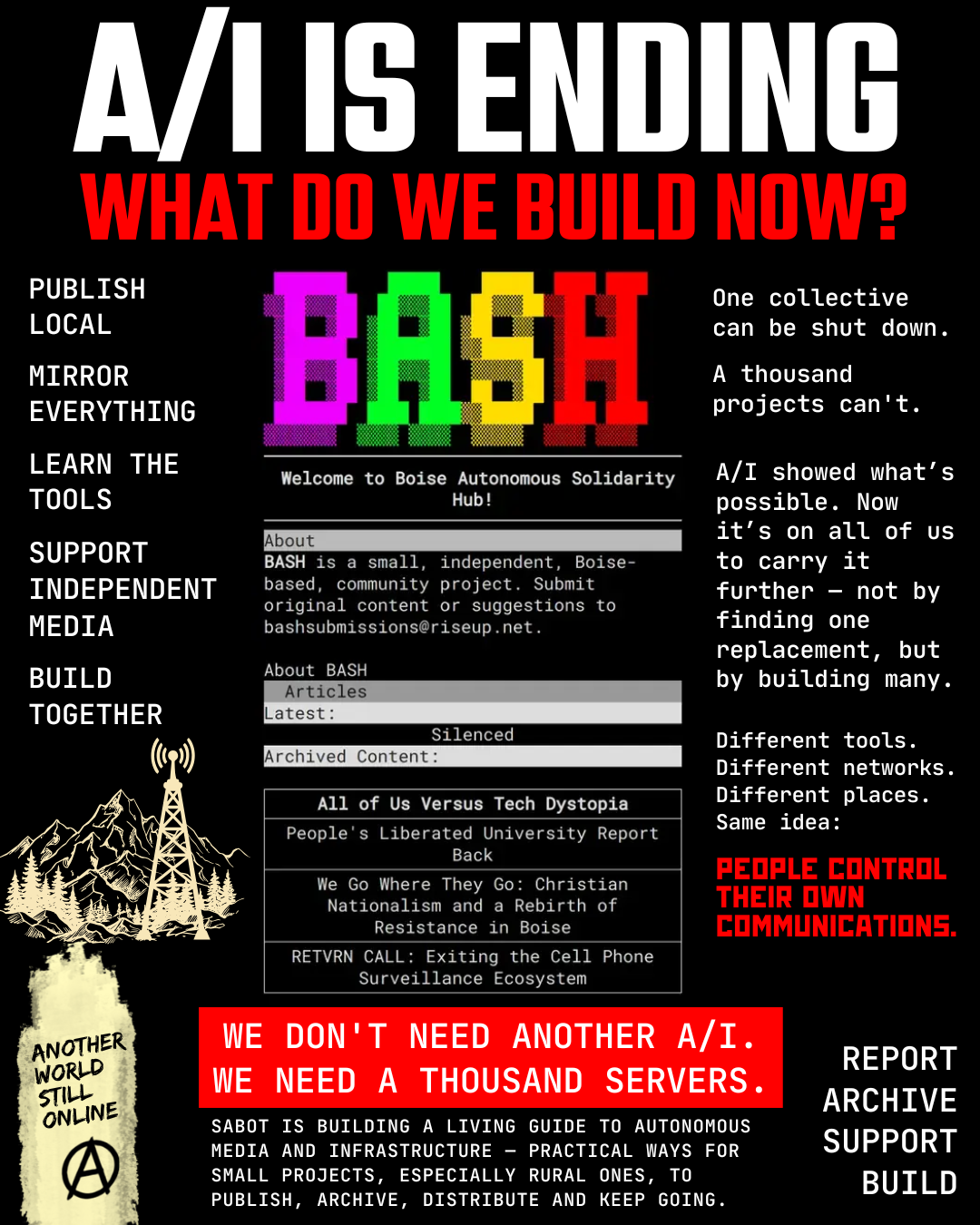
For twenty-five years, #AutisticiInventati showed what it could mean for movements to build and control their own communications infrastructure. Its loss should not send everyone searching for the next single service to replace it.
It should send us looking in a hundred directions.
In Boise, the Boise Autonomous Solidarity Hub is experimenting with one of them. @BASH has put a small independent publication on NomadNet, a system running over Reticulum rather than relying solely on the conventional web. It has articles, archives, submissions and contact functions, reachable through a cryptographic network destination instead of an ordinary domain.
99a904b9ab830b7baa9d5115eb8854d7:/page/index.mu
That is not the answer. That's what makes it interesting.
Other projects are trying other things: cooperative infrastructure, self-managed servers, RSS, mirrors, print, radio, downloadable archives, federated publishing and networks that barely resemble the commercial web at all.
We don't need to find another A/I. We need to understand how to build a thousand different pieces of what made A/I possible.
Sabot is beginning a living guide to autonomous media and infrastructure, aimed especially at small and rural projects: how to publish, archive, distribute, host, mirror and keep going when a platform, host, domain, provider or collective disappears.
Coming Soon:
BECOME THE THOUSAND SERVERS
A living guide to autonomous publishing, infrastructure and survival
Follow the people experimenting. Follow small radical media. Preserve what matters.
Then build something.
Technology Coordinator / Rhizomatica.
Se unió el ago 2021